Parking lot paving is one of those projects where a simple square-foot price can be useful, but it can also be misleading. A clean retail lot with good drainage and a stable base is not the same job as a cracked industrial lot with truck traffic, soft subgrade, poor slopes, and failing catch basins.
That is why a good Asphalt Parking Lot Cost Calculator should do more than multiply length by width. It should help you think like an estimator: measure the area, choose the right asphalt thickness, convert square feet to tons, add waste, consider truck loads, and then account for site work, drainage, labor, striping, and maintenance.
This guide is written for the way parking lot work is actually priced in the field. If you own, manage, or estimate commercial property in the United States, use it to build a practical budget before you call contractors or compare bids. When you are ready to run numbers quickly, use the Asphalt Pro Calc calculator to estimate area, tonnage, material cost, and truck loads.
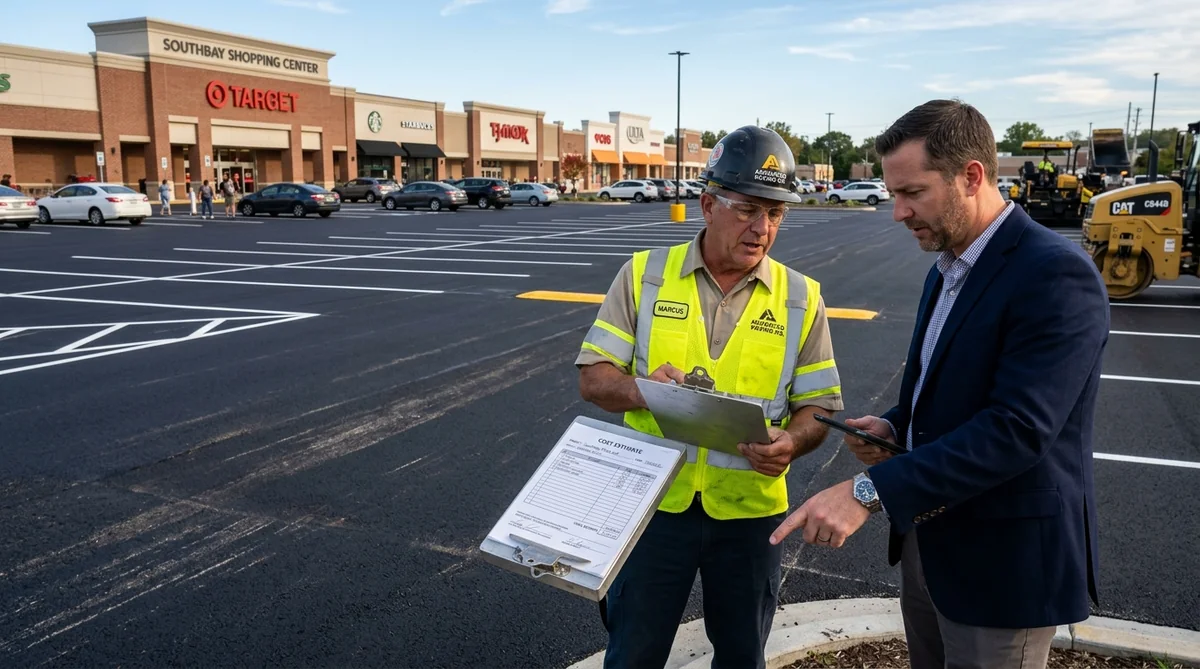
What Is an Asphalt Parking Lot Cost Calculator?
An asphalt parking lot cost calculator is a planning tool that estimates paving quantities and budget ranges based on project measurements. At the most basic level, it takes the square footage of a parking lot, applies the asphalt thickness, converts that volume into tons, and multiplies the tonnage by asphalt cost per ton.
A useful calculator goes a step further. It lets you account for waste factor, truck capacity, unit system, and cost assumptions. A strong estimate also separates material cost from installed project cost because commercial asphalt paving includes labor, equipment, trucking, preparation, compaction, layout, and cleanup.
The calculator does not replace a site visit. No online pavement calculator can see soft base areas, blocked drainage, ADA slope issues, curb damage, oil-soaked pavement, or buried utility problems. But it can give you a credible starting point so you are not walking into a contractor conversation blind.
Why Accurate Parking Lot Cost Estimation Matters
Commercial paving is expensive enough that small errors become real money. Underestimate thickness by one inch on a large lot and the material shortfall can be several truckloads. Forget waste factor around islands and curb lines and the crew may be short before the job is finished. Ignore drainage and the new pavement may start failing before the owner gets full value from the investment.
Accurate estimating helps with three things: budgeting, scope control, and bid comparison. A property manager can decide whether resurfacing fits this year’s capital plan. A contractor can check whether the plant order is realistic. A business owner can compare proposals based on compacted thickness, repair scope, and included items instead of picking the lowest number on the page.
In my experience, the best paving decisions happen when everyone understands what is included. The asphalt parking lot paving cost is not just blacktop. It is a system: subgrade, base, drainage, asphalt mix, compaction, markings, traffic flow, and maintenance plan.
Average Asphalt Parking Lot Costs in 2026
Across the United States in 2026, a practical planning range for asphalt parking lot paving is often around $3 to $8 per square foot. Some light resurfacing projects may come in lower. Full replacement, heavy base repair, trucking constraints, poor drainage, night work, or strict traffic control can push the cost higher.
For material-only estimating, hot-mix asphalt is often budgeted by the ton. A broad planning range is commonly $100 to $180 per ton, but local asphalt cost per ton can move with oil prices, plant distance, mix design, state, city, order size, and seasonal demand.
| Project Type | Typical Planning Range | Notes |
|---|---|---|
| Light overlay | Lower end of installed range | Only if existing pavement and drainage are sound |
| Standard commercial paving | $3–$8 per sq ft | Varies by thickness, access, prep, and region |
| Full replacement | Often higher | Removal, base repair, drainage, and disposal add cost |
| Material-only asphalt | $100–$180 per ton planning range | Confirm with local plant or supplier |
Parking Lot Cost Per Square Foot Breakdown
Cost per square foot asphalt paving is popular because it is easy to understand. A 30,000 square foot lot at $5 per square foot gives a quick $150,000 planning number. The problem is that the same 30,000 square feet can mean very different work depending on thickness and site conditions.
Here is how I like to break it down before trusting a number:
- Area: How many square feet are actually being paved?
- Thickness: Is the estimate based on 2 inches, 3 inches, 4 inches, or more?
- Scope: Is this an overlay, mill and overlay, patch and pave, or full reconstruction?
- Prep: Are base repairs, grading, and drainage included?
- Finish items: Is striping, ADA marking, signage, wheel stops, and cleanup included?
A low square-foot price can be perfectly legitimate on a clean, easy overlay. It can also be a warning sign if it leaves out the work that makes the pavement last.
Factors That Affect Asphalt Parking Lot Costs
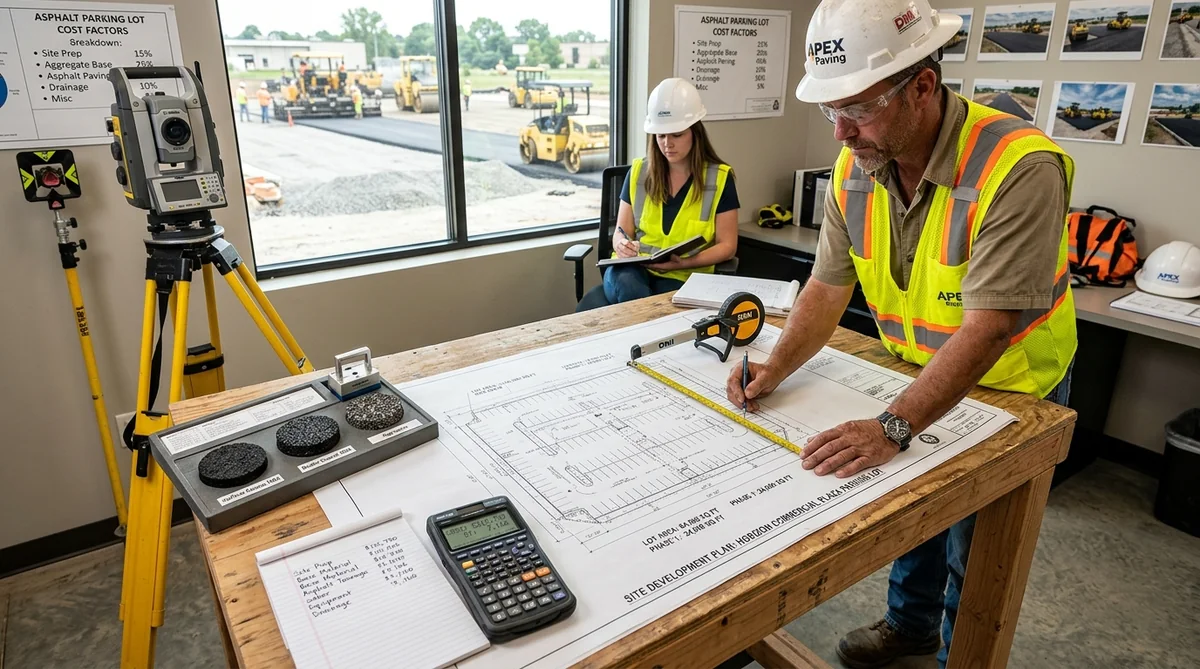
Parking Lot Size
Size drives quantity, but larger projects do not always scale in a straight line. A small lot may have a higher cost per square foot because mobilization, trucking, and setup are spread over fewer square feet. A larger lot may get better production efficiency, but it can also require phasing, traffic control, more trucks, and longer paving windows.
Asphalt Thickness
Thickness is one of the biggest cost drivers. Going from 3 inches to 4 inches increases asphalt quantity by about one-third. Passenger-car parking areas may not need the same thickness as delivery lanes or dumpster approaches. Heavy-duty areas should be designed for the traffic they carry.
Site Preparation
Good paving starts before the first load of asphalt arrives. Sweeping, layout, saw cutting, edge preparation, tack coat, utility adjustments, and traffic staging all take time. If the existing surface is dirty, loose, oily, or uneven, the prep cost rises.
Excavation
Excavation comes into play when the existing pavement or base is failing. Removing asphalt, hauling debris, correcting soft areas, and adding compacted aggregate base can add significant cost. It is also the work that often prevents future failure.
Drainage Systems
Water is one of asphalt’s biggest enemies. Catch basins, inlets, trench drains, swales, slope correction, and pipe repairs can change the budget quickly. If a contractor ignores drainage, the new surface may look good at first but fail early around low spots and ponding areas.
Labor Costs
Commercial asphalt paving needs a coordinated crew: paver operator, roller operators, laborers, lute workers, truck drivers, foreman, and sometimes traffic control staff. Labor cost depends on region, crew size, wage rates, union requirements, schedule, and whether work must be done at night or in phases.
Material Costs
Material cost includes asphalt mix, tack, aggregate base, patching material, and sometimes geotextile or specialty products. Asphalt cost per ton changes by market and mix. A surface mix for a retail lot may price differently than a binder course or heavy-duty commercial mix.
Location
Pricing in Texas, Florida, California, New York, and the Midwest can differ because of labor rates, aggregate sources, regulations, fuel cost, and plant distance. Rural jobs may have longer haul times. Urban jobs may have tighter staging and traffic control requirements.
Accessibility
Access affects production. A wide-open lot near the asphalt plant is easier to pave than a tight medical office lot that must remain open all day. Gates, overhead wires, curb islands, parked vehicles, narrow entrances, and business-hour restrictions can slow the job down.
Striping and Markings
Striping is usually a separate line item, but it belongs in the full parking lot paving estimate. ADA stalls, fire lanes, directional arrows, crosswalks, stop bars, loading zones, numbering, and wheel stops all add cost. A clean striping plan also helps traffic flow and compliance.
Commercial Parking Lot Cost Examples
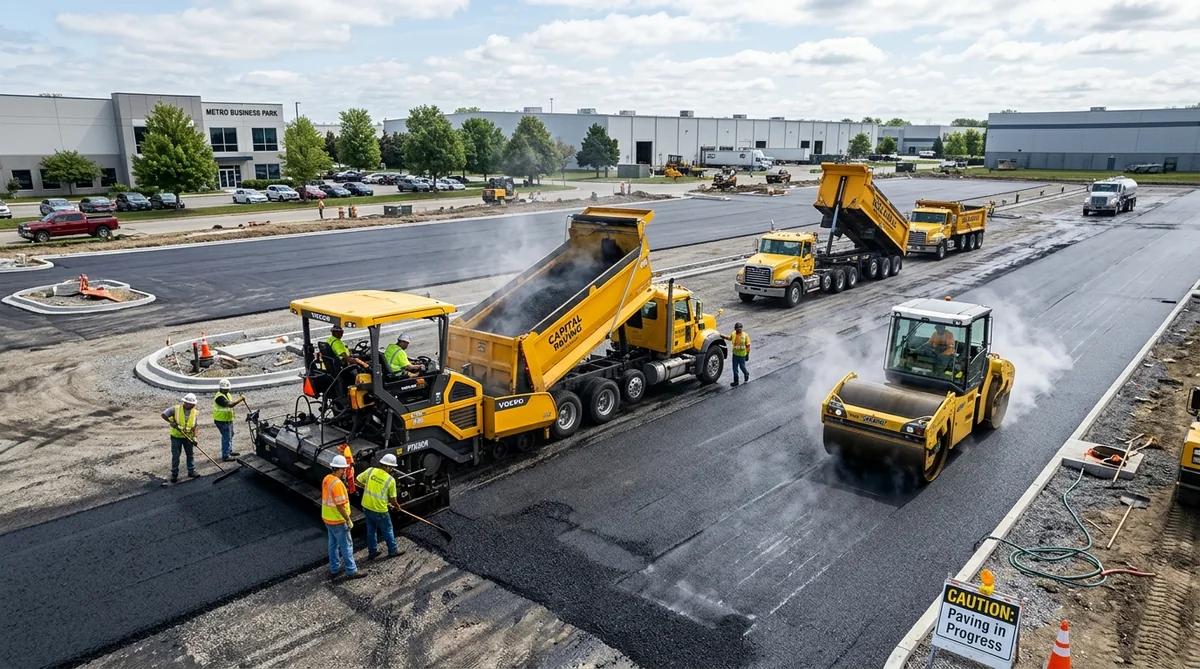
The following examples use a planning density of 145 lb per cubic foot, a $150 asphalt cost per ton, and a 7% waste factor. Actual quotes will vary, but the math shows how an asphalt calculator square feet to tons approach works.
Example 1: Small 20-Car Office Lot
Assume a small office lot with about 6,000 square feet of paving at 3 inches compacted thickness.
- Base tons: 6,000 × 3 × 145 ÷ 24,000 = 108.75 tons
- With 7% waste: 108.75 × 1.07 = 116.36 tons
- Material at $150/ton: $17,454
- Estimated truck loads at 20 tons/load: 6 loads
Installed cost could reasonably fall somewhere around $21,000 to $48,000 depending on prep, base repairs, striping, access, and regional pricing.
Example 2: Retail Parking Lot Resurfacing
Assume a 25,000 square foot retail lot with stable base, minor repairs, and a 2-inch overlay.
- Base tons: 25,000 × 2 × 145 ÷ 24,000 = 302.08 tons
- With 6% waste: 320.21 tons
- Material at $150/ton: $48,032
- Estimated truck loads: 17 loads
Resurfacing cost will also include cleaning, tack coat, patching, transitions, and restriping. If milling is required at entrances or curb lines, the budget increases.
Example 3: Larger Commercial Lot Replacement
Assume a 60,000 square foot commercial lot with 4 inches of asphalt planned for heavier traffic areas.
- Base tons: 60,000 × 4 × 145 ÷ 24,000 = 1,450 tons
- With 8% waste: 1,566 tons
- Material at $150/ton: $234,900
- Estimated truck loads: 79 loads
This is where project management matters. Truck timing, staging, roller coverage, inspection, and traffic routing can make or break production.
How to Use an Asphalt Parking Lot Cost Calculator
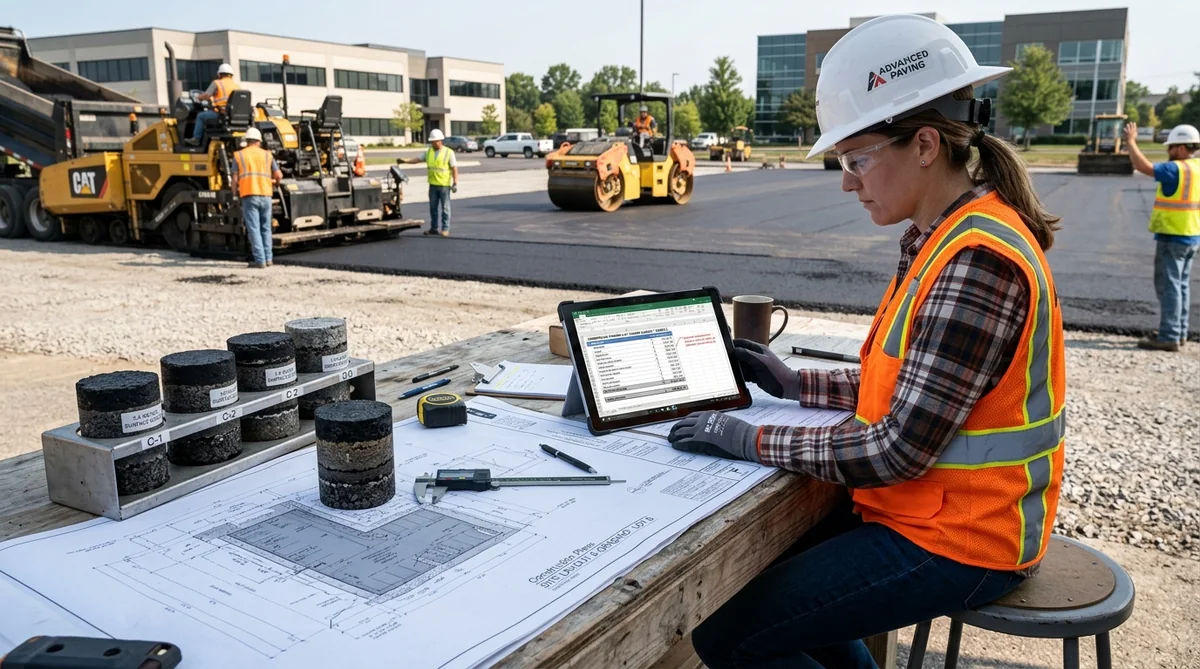
To use an online asphalt calculator properly, start with accurate measurements. If you know the total square footage, use that. If not, break the lot into rectangles, triangles, and drive lanes. Add each section together. Do not forget loading zones, entrances, dumpster pads, and drive aisles.
- Enter the area: Use square feet or length and width.
- Choose thickness: Pick a compacted depth based on traffic.
- Enter asphalt cost per ton: Use a local plant number if available.
- Add waste factor: Use 5% for clean layouts and 8% to 10% for complicated lots.
- Check truck loads: Divide total tons by truck capacity.
- Add non-material costs: Base repair, labor, drainage, striping, permits, and traffic control.
The Asphalt Pro Calc asphalt calculator is useful for the first part of the estimate: area, volume, tonnage, cost, and truck loads. For a final bid, combine calculator output with a site review from a qualified contractor.
Common Cost Estimation Mistakes
The most common mistake is comparing bids that are not quoting the same work. One contractor may include milling, patching, and striping. Another may quote a thin overlay with minimal prep. Both may call it “parking lot paving,” but the final product is not equal.
Other mistakes include using residential driveway thickness for commercial traffic, forgetting waste factor, ignoring drainage, measuring only parking stalls but not drive lanes, leaving out ADA markings, and assuming every truck holds the same tonnage. Another big one is overlooking business access. If the lot must remain open, phasing can add labor and time.
Parking Lot Repair vs Replacement Cost
Parking lot repair cost is usually lower than replacement cost, but only when the existing pavement is worth saving. Crack sealing, patching, sealcoating, and resurfacing can extend service life when the base is stable. If the lot has alligator cracking, rutting, pumping, major potholes, or ponding water, patching may only buy time.
Resurfacing, also called overlay, places new asphalt over existing pavement. It works best when cracks are limited, drainage is acceptable, and the base is sound. Full replacement removes failed pavement and rebuilds the structure. It costs more upfront but can be the better long-term decision for heavily damaged lots.
| Option | Best For | Watch Out For |
|---|---|---|
| Crack sealing | Keeping water out of active cracks | Does not fix base failure |
| Patch repair | Localized potholes or failed areas | Too many patches may signal replacement |
| Resurfacing | Stable pavement needing a new wearing surface | Existing cracks may reflect through |
| Replacement | Structural failure, poor drainage, major rutting | Higher upfront cost but better reset |
How to Reduce Asphalt Paving Costs
The best way to reduce commercial asphalt paving cost is not to buy the cheapest job. It is to define the correct scope. Measure the lot accurately. Fix drainage before overlaying. Repair base failures before they spread. Separate passenger-car areas from truck lanes. Schedule work so the crew can pave efficiently. Keep vehicles out of the work area before the crew arrives.
If you are getting multiple quotes, give each contractor the same scope: square footage, desired thickness, repair areas, striping requirements, and access rules. Ask each bidder to identify exclusions. A clean scope reduces surprises and makes pricing easier to compare.
Benefits of Using an Online Cost Calculator
An online calculator gives you speed and clarity. You can test different thicknesses, compare asphalt cost per ton, estimate truck loads, and understand how waste factor changes the budget. It also helps non-contractors speak the same language as paving companies.
For contractors, a calculator is a quick check against hand math. For owners, it is a way to understand whether a proposal is in the right ballpark. For facility managers, it helps prepare capital budgets before the formal bid process begins.
Parking Lot Maintenance Costs After Paving
A complete paving budget should not stop on the day the roller leaves. Parking lot maintenance costs are part of ownership. A well-built asphalt lot still needs regular inspection, cleaning, crack sealing, occasional patching, and fresh pavement markings. The purpose is simple: keep water out of the pavement structure and keep traffic moving safely.
For many commercial properties, annual inspection is the cheapest insurance. Look for open cracks, low spots that hold water, loose edges, oil damage, clogged drains, and fading ADA markings. Small cracks are usually inexpensive to seal compared with the cost of letting water enter the base and create potholes.
Sealcoating is often discussed with parking lot maintenance, but it should not be treated as a miracle fix. It can help protect and refresh an aging surface when applied at the right time, but it will not correct structural failure, poor drainage, or weak base. If a contractor recommends sealcoating over severe alligator cracking, ask whether full-depth patching should happen first.
Restriping also belongs in the long-term budget. Clear lines reduce confusion, improve curb appeal, and support ADA compliance. For retail centers, medical offices, schools, churches, warehouses, and restaurants, striping is not just cosmetic. It affects traffic flow, pedestrian safety, fire lanes, loading zones, and customer experience.
Practical Budgeting Checklist Before You Request Bids
Before you send a parking lot project out for pricing, collect the basic information a serious estimator will ask for. This makes the quote faster, cleaner, and easier to compare.
- Measure or estimate the total paved square footage.
- Mark areas with potholes, rutting, alligator cracking, or standing water.
- Decide whether you want overlay, mill and overlay, patch repair, or full replacement evaluated.
- List traffic types: passenger cars, delivery vans, garbage trucks, fire lanes, forklifts, or tractor trailers.
- Identify business-hour restrictions, tenant access requirements, and phasing needs.
- Ask whether striping, ADA markings, wheel stops, signage, and traffic control are included.
- Request the proposed compacted asphalt thickness in writing.
- Ask contractors to separate major repair items from general paving cost.
This is where the calculator helps most. If you already know your rough tons and square footage, you can spot vague bids quickly. You do not need to be an engineer to ask better questions; you just need enough information to understand the scope.
Helpful Authority References
For engineering standards, pavement design, and asphalt best practices, useful references include the Federal Highway Administration, the National Asphalt Pavement Association, the Asphalt Institute, and state DOT pavement design manuals. Local requirements should always control final design, especially for drainage, ADA access, fire lanes, and heavy truck areas.
Frequently Asked Questions
How much does an asphalt parking lot cost in 2026?
Many commercial projects are budgeted around $3 to $8 per square foot, but the final cost depends on thickness, base condition, drainage, labor, access, striping, location, and whether the job is resurfacing or replacement.
How do you calculate asphalt tons from square feet?
Use: square feet × thickness in inches × 145 ÷ 24,000. This gives estimated tons using a common asphalt density. Add waste factor before ordering.
What is the best asphalt thickness for a parking lot?
Light passenger-car areas are often planned around 3 to 4 inches over a good base. Heavier commercial traffic, delivery lanes, and truck routes may need 4 to 6 inches or an engineered section.
How much does parking lot resurfacing cost?
Parking lot resurfacing cost depends on overlay thickness, milling, repairs, tack coat, striping, and access. It is usually cheaper than full replacement if the base is stable.
When should a parking lot be replaced instead of resurfaced?
Replacement is usually better when the lot has widespread base failure, severe alligator cracking, rutting, potholes, drainage failure, or repeated patch failures.
What is included in a parking lot paving estimate?
A complete paving estimate should define square footage, thickness, mix type, repairs, milling or excavation, base work, drainage, traffic control, striping, cleanup, and exclusions.
How many tons are in one truck load of asphalt?
Many dump trucks carry around 18 to 22 tons, and 20 tons is a common planning number. Local legal limits and truck type can change capacity.
Does striping come with asphalt paving?
Sometimes, but not always. Striping, ADA markings, arrows, fire lanes, wheel stops, and signage should be listed clearly in the proposal.
Can I pave over an old parking lot?
Yes, if the existing pavement is structurally sound and drainage works. If the old lot has base failure or major cracking, overlaying may only hide the problem temporarily.
How often should an asphalt parking lot be maintained?
Inspect it every year. Seal cracks as needed, keep drains clear, repair potholes quickly, and consider sealcoating only after the pavement has aged properly and is in suitable condition.
Expert Conclusion
A strong parking lot paving estimate is built from real quantities and real site conditions. Square-foot pricing is helpful, but it is only one piece of the budget. The better approach is to measure the lot, select the correct thickness, convert square feet to tons, add waste, plan truck loads, and then include base work, drainage, labor, striping, and maintenance needs.
If you want a fast and practical starting point, use the Asphalt Pro Calc calculator. For material planning, you can also read our guide on how much asphalt you need. If you are comparing paving scopes or have a suggestion for the tool, visit the contact page.