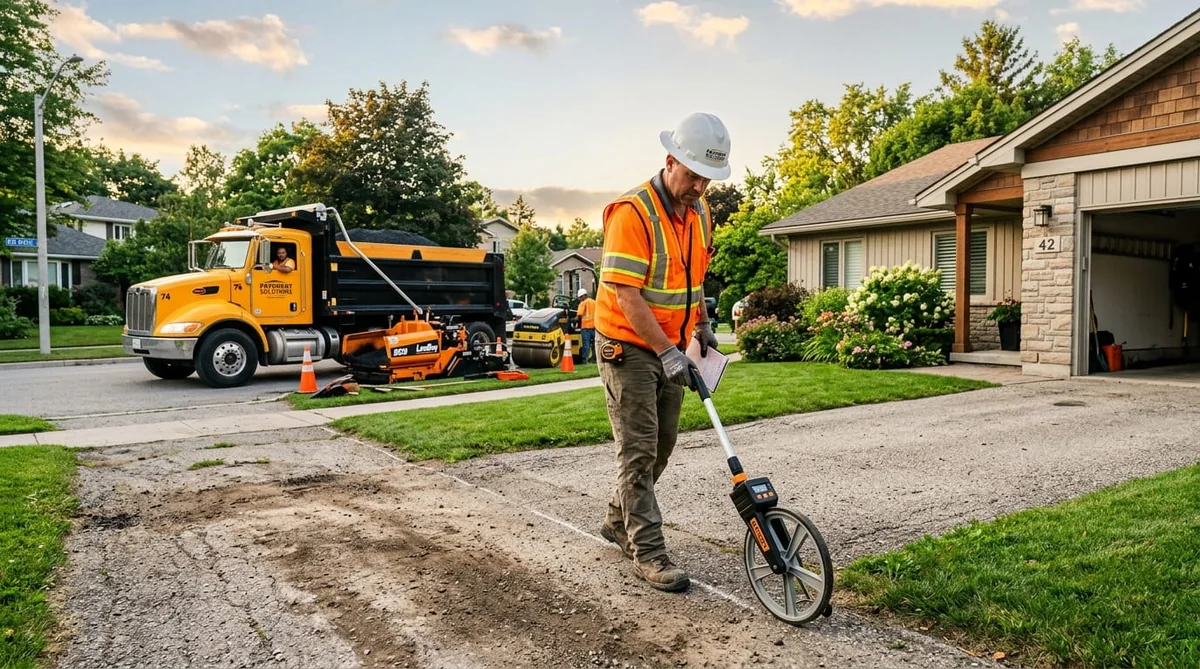
If you are planning a new driveway or replacing an old one, one of the first questions is simple: how much asphalt do I need for a driveway? It sounds like basic math, but in real jobs, small mistakes in measurement, thickness, or waste factor can cost you a lot.
I have seen homeowners order short and delay a project by a full day. I have also seen contractors over-order by several tons and eat the extra cost. The good news is that with the right method, you can estimate asphalt quantity accurately before you call the plant.
In this guide, I will break it down in plain language, using real driveway examples and field-proven estimating logic. You will learn how to calculate:
- Driveway area
- Asphalt volume
- Asphalt tonnage
- Truck loads
- Material cost with waste factor
Start with the Basics: Measure the Driveway Area
Most driveway estimates begin with square footage. For a rectangle, the formula is straightforward:
Area (sq ft) = Length x Width
For curved or irregular driveways, split the space into smaller rectangles or triangles, calculate each section, then add them together.
Example 1: 20x20 Driveway
20 ft x 20 ft = 400 sq ft
Example 2: 40x20 Driveway
40 ft x 20 ft = 800 sq ft
Example 3: 1,000 sq ft Driveway
If your measured driveway area is already 1,000 sq ft, you can use that directly in the tonnage formula below.
Choose the Right Driveway Thickness First
Thickness drives your tonnage. If you under-estimate depth, your estimate will be wrong even with perfect dimensions.
Typical residential asphalt driveway thickness:
- 2 inches: light-duty, smaller cars, lower traffic
- 3 inches: standard for most homes with SUVs/pickups
- 4 inches: heavier use, frequent larger vehicles
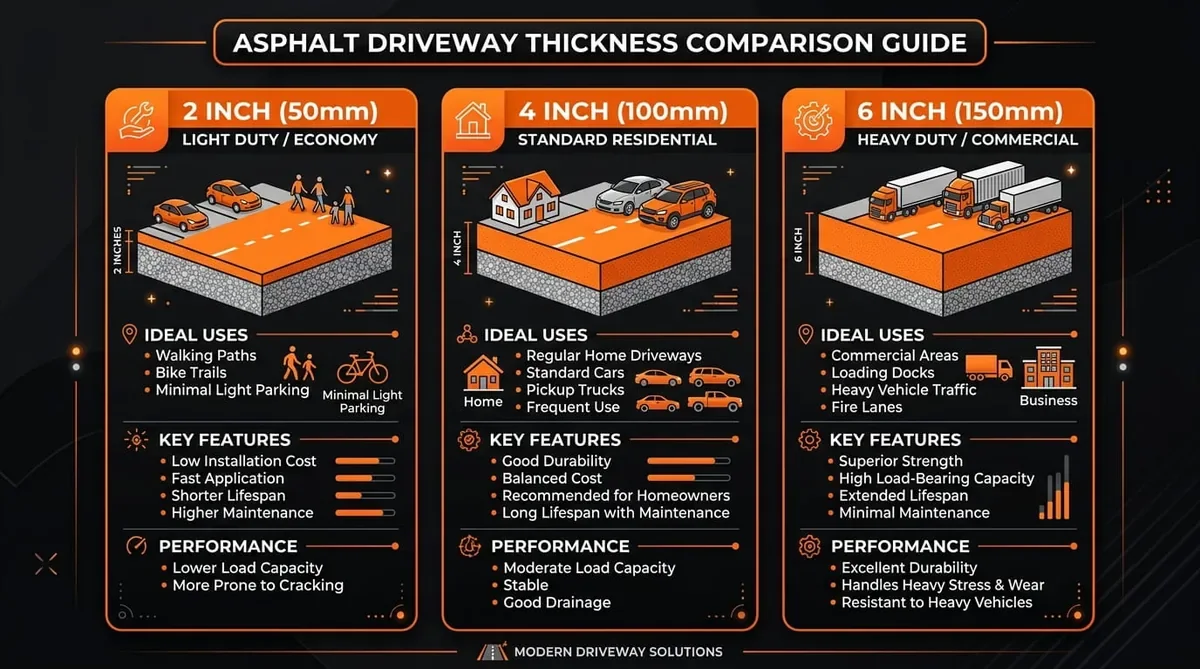
For most residential projects, 2.5 to 3 inches is a practical target when the base is prepared properly.
Asphalt Tonnage Formula (Simple Version)
Asphalt is sold by weight, usually tons. A common field estimating formula is:
Tons = (Area sq ft x Thickness in inches x 145) / 24,000
This assumes average hot-mix asphalt density around 145 lb per cubic foot. Different mixes vary slightly, but this is a reliable planning number.
20x20 Driveway Tonnage
Area = 400 sq ft
- At 2 inches: (400 x 2 x 145) / 24,000 = 4.83 tons
- At 3 inches: (400 x 3 x 145) / 24,000 = 7.25 tons
40x20 Driveway Tonnage
Area = 800 sq ft
- At 2 inches: 9.67 tons
- At 3 inches: 14.50 tons
1,000 sq ft Driveway Tonnage
- At 2 inches: 12.08 tons
- At 3 inches: 18.13 tons
Add Waste Factor (Do Not Skip This)
Real paving work always includes some material loss. Edges, transitions, hand work, and compaction variation all affect final usage.
Standard waste factor:
- Small/simple driveway: 5%
- Irregular shape or tight access: 8% to 10%
Adjusted tons = Base tons x (1 + waste percentage)
Example (40x20 at 3 inches):
Base = 14.50 tons
With 7% waste = 14.50 x 1.07 = 15.52 tons
Practical order amount: 15.5 to 16 tons
Truck Loads: How Many Deliveries Will You Need?
A standard asphalt truck often carries around 20 tons, but capacity can vary by local trucking setup and legal road limits.
Quick formula:
Truck loads = Total tons / Truck capacity
Then round up to the next whole load if needed.
Examples:
- 5.2 tons total -> 1 truck load
- 15.5 tons total -> 1 truck load
- 24 tons total -> 2 truck loads
Asphalt Volume Explained (For Better Planning)
Some teams prefer to think in volume before converting to tons. Volume is useful for understanding depth and compaction planning.
Formula:
Volume (cubic feet) = Area x (Thickness in inches / 12)
Example: 1,000 sq ft at 2 inches
Volume = 1,000 x (2/12) = 166.7 cubic feet
Then convert to tons using density.
What About Asphalt Cost?
Once your tonnage is right, cost estimation is simple.
Total material cost = Total tons x Cost per ton
If local asphalt cost is $140/ton and your adjusted quantity is 15.5 tons:
15.5 x $140 = $2,170 (material only)
Remember this does not include:
- Base prep or grading
- Removal of old surface
- Labor and equipment
- Edge work and compaction passes
Paving Process Snapshot (What Happens on Site)
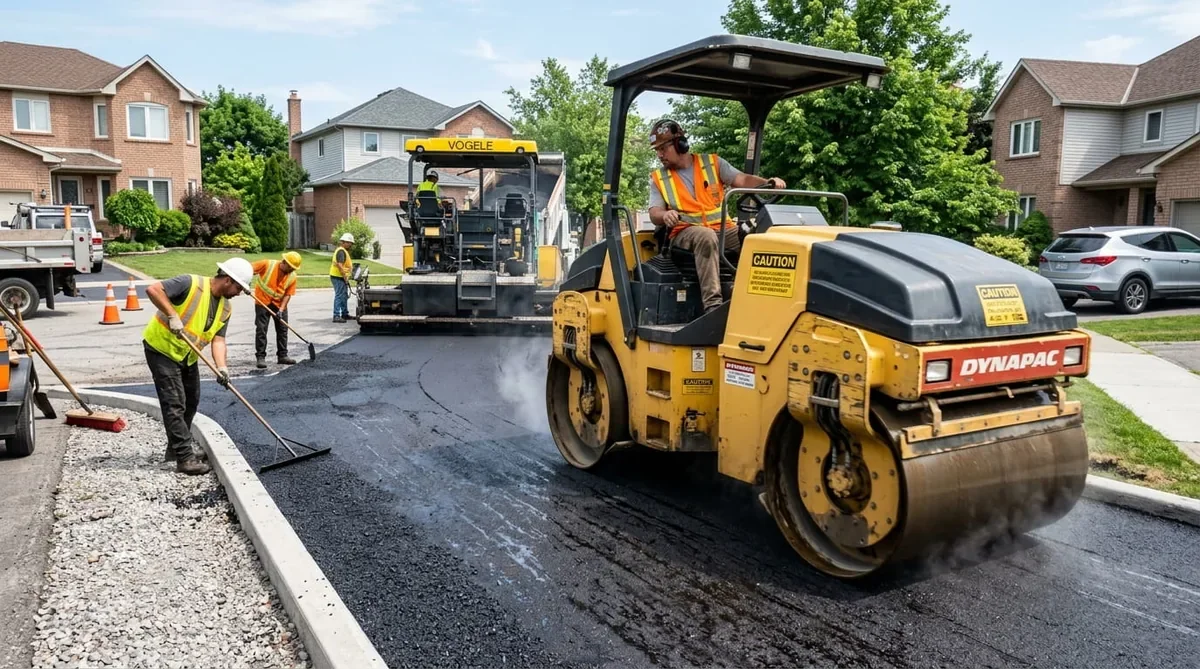
A professional driveway job usually follows this sequence:
- Measure and mark the driveway area
- Set final grade and drainage direction
- Prepare and compact the aggregate base
- Lay asphalt to target thickness
- Compact with roller to proper density
- Finish edges and clean transitions
Estimating correctly at step one keeps every step after that smoother.
Common Mistakes Homeowners Make
1) Using only square footage pricing
Square footage quotes without stated thickness can hide a weak spec. Always confirm inches of compacted asphalt.
2) Skipping waste factor
Even clean jobs need contingency. Ordering exact base tonnage is risky.
3) Ignoring base condition
If base is weak, adding more top asphalt does not fully fix structural issues.
4) Not verifying truck logistics
Delivery timing matters for paving quality. Asphalt cools quickly, especially in cold or windy conditions.
Fast Rule of Thumb (Good for Initial Planning)
If you need a quick estimate before full takeoff:
- At 2 inches: roughly 1 ton covers about 100 to 110 sq ft
- At 3 inches: roughly 1 ton covers about 70 to 80 sq ft
This is useful for rough planning, but for ordering, always use full calculations.
Final Recommendation
If you are still asking, "how much asphalt do I need for a driveway," here is the safest approach:
- Measure accurately
- Choose realistic thickness
- Calculate tonnage with density
- Add 5% to 10% waste
- Confirm truck capacity and local price per ton
If you also want to price the job, read our asphalt driveway cost calculator guide for square-foot, tonnage, base prep, and labor examples.
For a fast and accurate estimate without manual mistakes, use the Asphalt Pro Calc calculator. Enter your dimensions, thickness, and cost per ton to get area, tons, volume, total cost, and truck loads in seconds.